The King Team, powered by RE/MAX Patriot Realty

What it costs to run a home:
water

Private wells against town water, filters and softeners for better water, and the ways a home makes hot water.

Part of The King Team series on what it costs to run a home

Broker & OwnerDavid King256.803.5600David King
Associate BrokerFiona King205.901.5900Fiona King
AgentHeather Gilmer256.578.7700Heather Gilmer
AgentSharon Miller256.318.9001Sharon Miller
In this article
  1. Well water or town water
  2. Filters and softeners for better water
  3. Town water
  4. Hot water
David KingBroker & Owner, RE/MAX Patriot Realty
Ask a question

Well water or town water

Water is the most important part of the home; without water, you cannot move in. Water comes to the property in 2 ways: a private well or town water.

Shallow wells

Private water is typically drawn from either a shallow well or a deep well. A shallow well is typically not more than 15' deep and in most cases is a large casing in the ground. Many of these wells have a draw pump, which pulls the water out of the well and then pushes it into the home. These wells are old, and most towns will discourage and even disallow them. The problem with these wells is that the large cap over the well top can be removed by a person. Should a small animal, like a squirrel or mouse, fall into the well, this could contaminate the water and make you very sick. Plus, since these wells draw from water that is close to the surface, a spill of paint, chemicals, oil, etc. can get into the water supply without you knowing and poison the water. Again, you get sick.

Deep wells

For a deep well, a well company comes to the property and drills a 6" well down into the ground until they hit water. In many parts of our area, a steel casing is inserted into the ground to the level of the bedrock, and then they keep drilling through the bedrock until they get water. Some wells end up 800' deep. If they get to a level that is considered deep enough and they still cannot get enough flow (they want 5 gallons a minute, and each town has a minimum gallons per minute flow required), they will hydrofracture the well. This is where they bring in a large pump truck full of water and force the water into the ground, hoping to open up lines in the bedrock and release the water. If this fails, they have to move to a different spot on the property and drill again. Ouch. It is not uncommon to spend over $10,000 on a deep well. Plus, in most towns, the deep well must be more than 100' away from any septic system. That means 100' from the one on your property and the one on your neighbor's property. Anything less could require a town variance.

Filters and softeners for better water

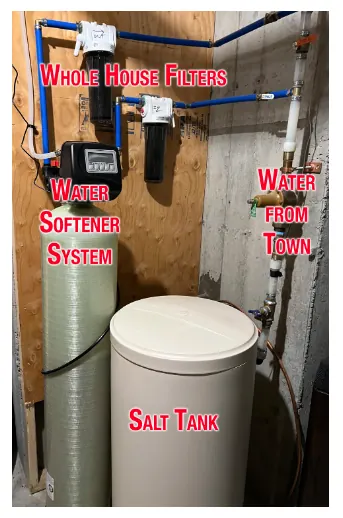
Well water, shallow or deep, can have a bad smell and taste and can be hard water. You can fix this with filters and a water softener system. The filter you want is a whole house filter; get 2 of them. Put the white sediment filter into the first one and connect it to the water supply. Then go from this filter into the water softener, and when the water comes out, go to the carbon filter (black). Now you have great water, and all the water in the house, from the showers to the ice cubes, is fresh and clean.

If you have high iron water (the water is rust colored), get the salt pellets or crystals for the softener that are made for high iron. They are about $1.50 more per bag, and they work great.

The whole filter system costs about $800 if you install it yourself, and it is well worth it.

I have one in our home for the town water, and my water is great. The photo below shows a water softener system with two whole house filters, a salt tank and a softener. This system is fully automatic and cleans itself every night at 2 am, but you must fill the salt container and change the filters when needed.

A whole house filter and softener system

Town water

Town water is good and bad. The good part of town water is that it is always on, even if the power goes off. But you pay for it. In Massachusetts, in the town where we have a home, the cost is $9.60 per 1,000 gallons, but in Cullman, AL the rate is $27.51 for the first 2,000 gallons (a monthly fee is included in this cost), and after that the rate goes down.

Now, some people think that if they have a well, the water is free. Not true. The pump required to get water out of the ground uses electricity, and based on the article on electricity, the average well pump uses 1,400 watts per hour, so I would not expect much of a savings over town water. Plus, you need a generator if you want water when the power goes out. If you have an irrigation system, that is a whole different set of numbers.

A note about town water: most towns add chlorine and fluoride to the water. Both of these help keep the water safe and clean and help with children's teeth.

Hot water

Hot water is what you use for your bath or shower, sinks, washing machine, dishwasher, etc. Today, when a new home runs on natural gas or propane, hot water is typically produced by an on-demand system. The same system that provides the hot water for the heat in the home is the same unit that provides the hot water. The new on-demand systems have a separate water line for the hot water storage tank, while the rest of the home is controlled by the circulator pumps.

How the hot water storage tank (sometimes called a SuperStor tank) works is that it has a coil in the center of the tank that connects to the hot water line from the on-demand system. So you have hot water going through a coil in the center of the hot water tank that heats the water. A boiler that runs on oil, wood, coal, corn, etc. can also run a hot water storage tank.

If you want to use a conventional hot water heater, then you have many sizes (40 gallons is the most popular, but larger families are moving to 60 to 80 gallons these days). Your choices are natural gas or propane, oil, or electric. Electric does not need a vent, but the other choices need a vent.

A note for oil run boilers, furnaces or hot water tanks: you do not need a chimney to vent the units. You can have a power vent installed, so the heat and fumes are run through a vent in the side of the house, with a fan that moves lots of air with the heat and fumes through the vent to keep the temperature of the vented gases down.

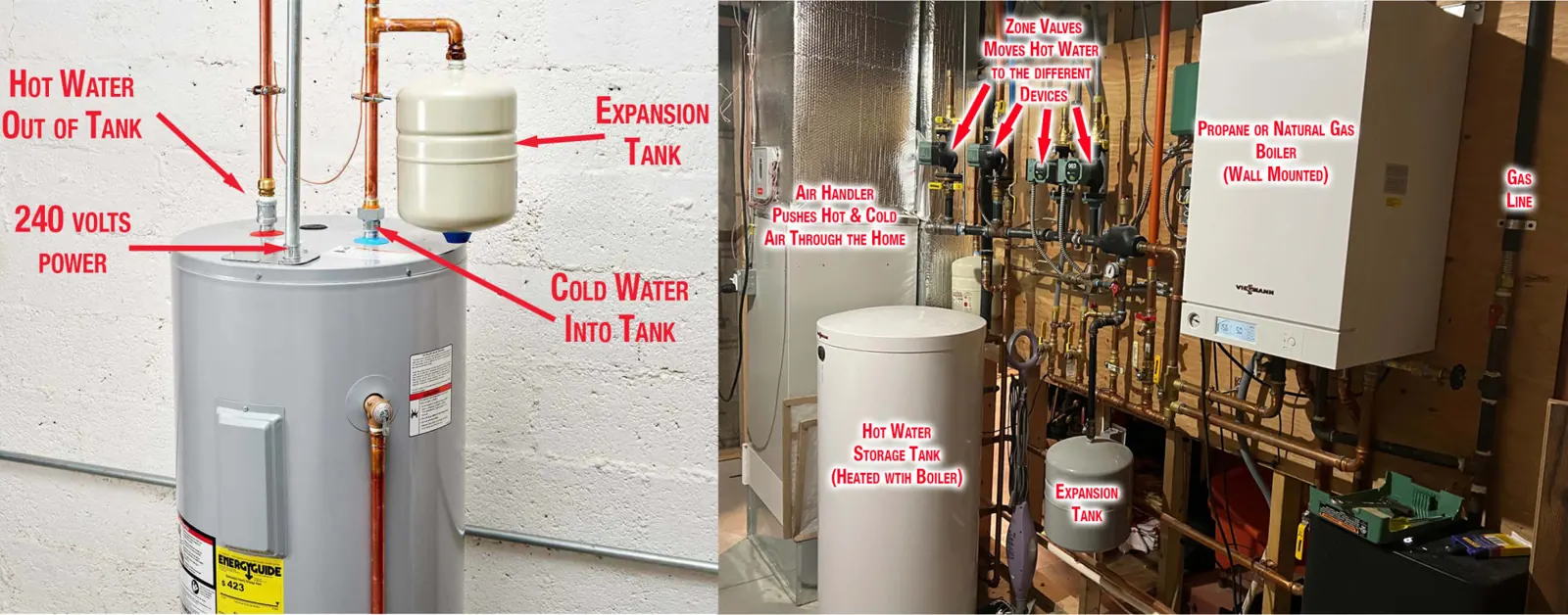
The photo below shows a typical electric hot water heater, and next to it a hydronic system with propane as the heating fuel: a wall-mounted boiler, a storage tank for hot water, and an air handler that moves the hot and cold air through the home. The hydronic system is a whole house heating system, including hot water. The air handler also provides AC to the home.

An electric water heater and a hydronic system

About The King Team

We hope you enjoyed this blog. Please come back for more.

David and Fiona King of The King Team are a dynamic duo leading a group of seasoned professionals specializing in various real estate sectors. The team's broad expertise spans new home construction, subdivision and land development, commercial property, and multi-family and single-family homes.

David and Fiona are committed to making the buying or selling journey enjoyable and informative. The team prides itself on excellence in customer service, always prioritizing their clients' interests in every transaction. Contact them today to get started.

Beyond their real estate prowess, The King Team also holds expertise in lake home sales and acquisition, land development and commercial real estate, providing a comprehensive service to their clients. The team is devoted to realizing their clients' real estate dreams and is eager to cultivate long-lasting relationships built on trust and mutual respect.

David and Fiona King of The King Team have over 40 years of experience and over 125 five-star reviews. With their top-tier service and professional guidance, you can confidently navigate your next real estate journey.

Thinking about listing your home?

No other agents do what The King Team does for their sellers. From the custom signs, large EDDM mailers, 3D virtual tours and so much more, call The King Team to discuss listing your home at 888.THE.KING (888.843.5464).

Meet the team that exceeds your expectations

David King, Fiona King, Heather Gilmer and Sharon Miller of The King Team

Discover why we are rated #1 in buying and selling real estate in Lewis Smith Lake, Cullman, Jasper and the surrounding areas.

Explore Smith Lake and surrounding countiesUnited States Census Bureau TIGERweb geometry for Cullman, Walker and Winston Counties, exact Lewis Smith Lake water polygons and captured primary roads. County outlines are administrative boundaries, not listing search criteria or guarantees of service areas. Hydrographic data is decorative context, not navigation or current shoreline guidance. Select a county to open its existing homes page.Cullman CountyWalker CountyWinston County

Buying a home on a well or town water?

David and Fiona King lead The King Team at RE/MAX Patriot Realty, with expertise spanning new home construction, land development, commercial property, lake homes and single-family homes across Cullman, Jasper and Lewis Smith Lake. Call 256.803.5600 or 888.THE.KING, or visit the office at 3850 AL 69 S, Cullman, AL 35057.

×.
David King

Broker & Owner

David King

“Your realtor should be your advisor, to protect you, and help you find the ideal home/property for your wants and needs.”
256.803.5600Email David