




What it costs to run a home: water
Shallow wells, deep wells and town water compared, a simple whole house filter and softener setup, and how water heaters and hydronic systems make hot water.
Read the articleWhat it costs to run a home: water


(256) 803-5600
REMAX PATRIOT REALTY




How power comes into a home, how to read the bill, and what lights, appliances and electric heat really cost to run.
This article is part of a series designed to help you understand how it works and what you can do to save money or make your home run more efficiently.
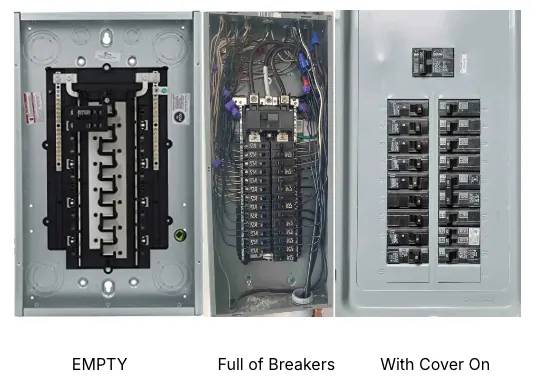
First, let's start with electricity in North America. All homes have 220/240 volts coming into the home, broken down into 3 wires: two hot wires with 110/120 volts per wire, and one common wire that does not have electricity running through it but connects to the pole and the town or city. In your electrical box are two bars (as they call them), and each bar carries one charge of 110/120 volts. So when you look at your electrical box, you will see some breakers with just one switch and some with 2. The ones with 2 are all 220/240 volts, for items like dryers, stoves, AC, heat, etc. All the single switches are for standard plugs, lights and items in your home that only use a single plug to run.
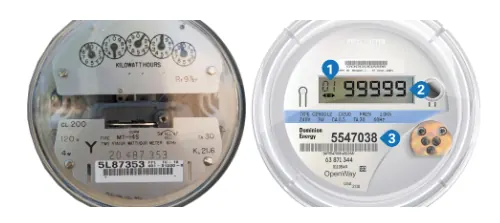
These are the two types of electric meters you should see on your home or business. The one on the left is the standard older version, mechanical, and the one on the right is the new digital meter. The newer meters communicate with the power company and have intelligence built in, so they can talk to the power company and give them statistics on your power usage.
Electricity is all math. Yes, sorry, but no surprise here: you can calculate the cost of anything if you know the following:
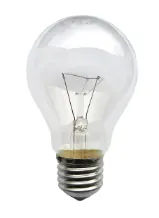
All electric costs are based on watts used. Now, the bills are a little confusing because you see a cost for the actual electricity of, let's say, $.12 per kW. This means that for every 1,000 watts per hour you use, you pay $.12. What you must read further into your bill is the other costs, like delivery, taxes, etc. In Massachusetts today the rates range from $.21 to over $.38 with all the fees in the final number (for our examples we will use National Grid at $.27). In Alabama with Cullman Electric, the total delivered cost is $.1257 (12.5¢). Based on these numbers, if you have a 100 watt light bulb (the old incandescent kind) and you turn it on at 9 pm and turn it off in the morning at 7 am (10 hours), you have used 1,000 watts, also known as 1 kW.
So let's do a little simple math. A 100 watt light bulb on your back porch runs every night from dusk (say 9 pm) to dawn (say 7 am). This is 10 hours at 100 watts, which is 1,000 watts, or 1.0 kW per day, times 31 days for a total of 31,000 watts, or 31 kW. Here are the costs for just that one old light bulb:
Now let's look at the security light on the garage, assuming you have a halogen light that you turn on at dusk and off at dawn. These types of lights are typically between 150 and 500 watts.
| Light size | Massachusetts | Alabama |
|---|---|---|
| 150 watts (45 kW) | $12.55 per month | $5.65 per month |
| 300 watts (90 kW) | $24.30 per month | $11.31 per month |
| 500 watts (155 kW) | $41.85 per month | $19.48 per month |
As you can see, just one 500 watt halogen security light, if replaced with a new LED light, would pay for itself in 2 to 4 months.
LED lights are rated in watts, but this is to show you the equivalent output of an LED bulb against an incandescent bulb. So the package might say 100 watt LED bulb, but the actual watts used is about 17 watts. Meaning you can use an LED bulb 590% more for the same money as an incandescent bulb of the same watts.
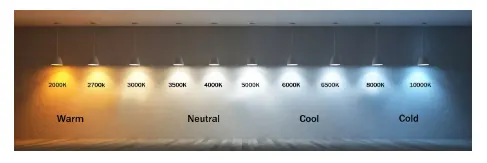
Since I am on the topic of LEDs, it is much more common with LEDs to have a rating called Kelvin and/or lumens. Kelvin is the temperature of the bulb, what I call the scale of light, and lumens is the intensity of the light. Warm light is 2000 to 2700K, neutral (soft) light is 3000 to 4000K, and daylight is typically 5000K. Most kitchens and bathrooms are daylight, while living and dining rooms are more of a warm light. This is all based on your taste and has nothing to do with watts or power consumption. Lumens is how bright the light is, not the temperature, so you can have a warm light that is equal to a 40 watt bulb or a 100 watt bulb. You will know 5000K bulbs because this is what most of the new cars have for headlights.
Here are some of the appliances in your home today, assuming new and Energy Star (if possible).
Keep in mind you only use most appliances for a short time. Things like the fridge, freezer, lights, portable heaters, etc. that you might leave on all day, or 24 hours a day, are the items you need to look at. Items like hot water tanks, AC units, heating units, dryers and well pumps tend to use a lot of power, but only when they need it. Most of these do not run all day long.
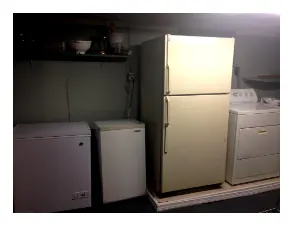
If you have an old fridge in your garage or basement keeping your beer and soda cold, you might want to consider getting a new, smaller fridge, as the old fridges typically use up 1,700 watts per hour, or 1,224 kW per month. That is $330 per month in MA or $153 per month in AL. Are you sure your cold beer is worth that? You can pay for a new fridge in less than a year.
If the house you want to buy has electric baseboard heat, the electricity used is as follows: 225 watts per linear foot. The most common sizes are 4' at $35 each and 6' at $60 each. The reason you find these in homes is that the cost to buy and install them is so much less than hot water baseboard. Plus, you can install them just about anywhere you have power. Keep in mind that they need a dedicated circuit, as they draw a lot of power, and most of them use 220 volts.
So say you have an old house with 4 rooms with electric heat. You can expect that for every 10 sq. ft. you will use approximately 10 watts per hour. So a 10' x 12' bedroom that has a 7' ceiling and OK insulation could use approximately 400 watts per hour, and if heated every hour in the winter, you can expect to pay about $2.00 per day, or $62 per month, so 4 rooms would cost approximately $248 per month.
One more note: home inspections are looking for failures in the home. A working electric heating system will not raise a red flag, but it will raise your blood pressure when you get your bill in January.
If you do not know what your devices are drawing for power in your home, you can buy a power flow meter from Amazon, Home Depot or Lowe's. Plug your device into one side of the meter and the other side into the wall, and the meter will tell you how much power the device is using. It only works for 110 volt standard plug units.
We hope you have enjoyed this blog. Please keep coming back for more helpful information.
David and Fiona King of The King Team are a dynamic duo leading a group of seasoned professionals specializing in various real estate sectors. The team's broad expertise spans new home construction, subdivision and land development, commercial property, and multi-family and single-family homes.
David and Fiona are committed to making the buying or selling journey enjoyable and informative. The team prides itself on excellence in customer service, always prioritizing their clients' interests in every transaction. Contact them today to get started.
Beyond their real estate prowess, The King Team also holds expertise in lake home sales and acquisition, land development and commercial real estate, providing a comprehensive service to their clients. The team is devoted to realizing their clients' real estate dreams and is eager to cultivate long-lasting relationships built on trust and mutual respect.
David and Fiona King of The King Team have over 40 years of experience and over 125 five-star reviews. With their top-tier service and professional guidance, you can confidently navigate your next real estate journey.
No other agents do what The King Team does for their sellers. From the custom signs, large EDDM mailers, 3D virtual tours and so much more, call The King Team to discuss listing your home at 888.THE.KING (888.843.5464).
Shallow wells, deep wells and town water compared, a simple whole house filter and softener setup, and how water heaters and hydronic systems make hot water.
Read the articleWhat it costs to run a home: water
How to size a generator from your electric bill, why propane beats gasoline, what portable and whole house units cost, and why a UPS keeps your router running.
Read the articleWhat it costs to run a home: generators
How heating zones save money, what oil, natural gas, propane, wood and pellets cost to burn, and how baseboard, hydronic and forced-air systems move the heat.
Read the articleWhat it costs to run a home: heat
Discover why we are rated #1 in buying and selling real estate in Lewis Smith Lake, Cullman, Jasper and the surrounding areas.
David and Fiona King lead The King Team at RE/MAX Patriot Realty, with expertise spanning new home construction, land development, commercial property, lake homes and single-family homes across Cullman, Jasper and Lewis Smith Lake. Call 256.803.5600 or 888.THE.KING, or visit the office at 3850 AL 69 S, Cullman, AL 35057.

Broker & Owner
“Your realtor should be your advisor, to protect you, and help you find the ideal home/property for your wants and needs.”256.803.5600Email David



Get instant property value now!