




What it costs to run a home: water
Shallow wells, deep wells and town water compared, a simple whole house filter and softener setup, and how water heaters and hydronic systems make hot water.
Read the articleWhat it costs to run a home: water


(256) 803-5600
REMAX PATRIOT REALTY




A septic system against a town sewer connection over 40 years, how septic systems work, and the four main types.
For all builders, town sewer is the best, but is it best for the homeowner? Let's do a few numbers to see if it works. A typical septic system costs between $15,000 and $50,000, and then you are told to pump it every few years. The average life of a septic system is 40 years. So let's go out 40 years and assume the system cost about $20,000. It costs about $350 to pump the system, so if you have it done every 2 years, that is about $7,000 over 40 years, for a projected total of $27,000. This is about $56.25 per month.
If you take the average home at 3.5 bedrooms and assume they use the max of 110 gallons per day (not realistic, as today we have so many water-saving devices), that is about 440 gallons per day. The average price for sewer in our local city is $4.21 per unit (a unit is 750 gallons), so in this case the cost of the sewer for that one day is $2.46, or $74 per month.
Now, that is a maximum number. Let's look at a real set of numbers: a 3-bedroom home flushes the toilet 6 times a day, has 3 showers a day, does 4 loads of laundry a week and runs the dishwasher 2 times a week. When you add all this up, you come to about 650 gallons per week. This changes the cost per month to about $15. Now take $15 and multiply it over 40 years, and the projected cost could be $7,200.
You can see that the cost of a town sewer connection is significantly less than a septic system in this case. You should do your own research for the town you are considering moving to before you make the decision to connect to the town or install a septic system.
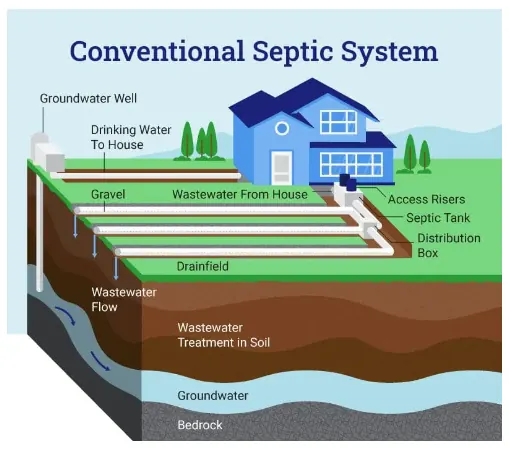
Septic systems are a way for your home or business to remove the waste water from the toilets, washing machine, dishwasher, shower, sinks and so on to a tank in the yard. They are commonly used in rural areas without centralized sewer systems. Each septic system is designed to meet the needs of the building that is attached to it. A septic system is made up of a tank or tanks, a distribution box and a leaching field. The tanks are sized to the number of bedrooms. The Title V rule is 110 gallons per bedroom, times 2, which gives you the tank size. Example: 4 bedrooms times 220 = 880, but you must have a minimum tank size of 1,500 gallons. Each town could have different rules, so you should check with your local health inspector.
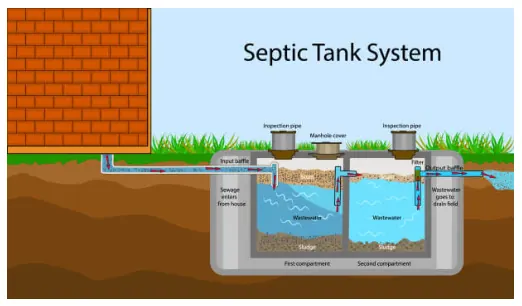
In a typical septic system, the waste water flows into the tank, the solids sink to the bottom, and the oils and items lighter than water float on top. Inside the tank is a pipe that lets the water out of the tank, from about 6" below the top water level, to a distribution box (D box). (This is not the way it works if you have an engineered system, which I discuss later in this article.) The reason the pipe sits below the water level is that you do not want the items floating on top of the tank to get into the leaching field pipes, as this will clog them and cause the system to fail.
The D box, as it is called, is a way to distribute the gray water (water that does not have solid waste) out to the leaching field pipes, which have holes in them and are buried in the ground in the yard. The gray water is absorbed into the ground.
In Massachusetts we have Title V. Title V is a set of rules defining the proper function of a septic system. When a house that has a septic system is to be sold, the owners should have a Title V test done on the system. The inspectors come to your property, most times with a small excavator, and dig down to the D box and the septic tank covers. They take the cover off the D box and put a camera up the pipe to the tank, and then through all the pipes in the septic field. They are looking for clogs or failures in the system. Then they pump the tank and inspect it. Should they find all systems working fine, they complete the Title V report with an overview of the home or building. The tank and system are designed for a set number of bedrooms, so if the home or building has been modified to have more bedrooms than the system was designed for, the home should be sold as defined by the septic system capacity.
If you are building a new home or replacing an existing septic system, there are a few ways to have a septic system. One is gravity fed, where the tank is downhill from the building and the field is downhill from the tank. This is the best system, and in most cases it is less expensive than the second type.
The second type is a raised system, which is needed because the water table is too high on the property. The water table determines the height of the septic field. To determine the water table, test holes are dug in the areas where the septic field is scheduled to be installed. They pour 10 gallons of water into the holes and count how long it takes for the water to dissipate into the ground. Along with this, they look at the type of soil they dug up and the ground colors, as this tells the experts about the conditions of the ground. Should the ground water be at a level that requires a raised system, they will create the septic field above the ground and then bring in special fill to make a large area for the septic field to drain properly. You will see this at lots of homes: a large mound with a white pipe on it. This is the vent pipe (called the stink pipe). The pipe is at the end of the septic field and helps vent the field.
Here are the 4 major types of septic systems. The first is standard, and the following 3 are all engineered.
The system uses 1 septic tank for gravity fed, or two tanks for a pump and grind system. Gravity fed is just what it sounds like: all the water flows downhill, first into the tank, typically 1,500 gallons, then to the D box. The D box distributes the gray water to the leaching field. The leaching field is perforated pipes in the ground that leach the gray water back into the porous ground. The pump and grind system consists of a smaller tank that is downhill from the home. All water and solids flow to the small tank. In the tank is a grinder pump that grinds up all the solids and pumps the gray water and the solids uphill to the septic tank. Then the system works just like a gravity fed system.
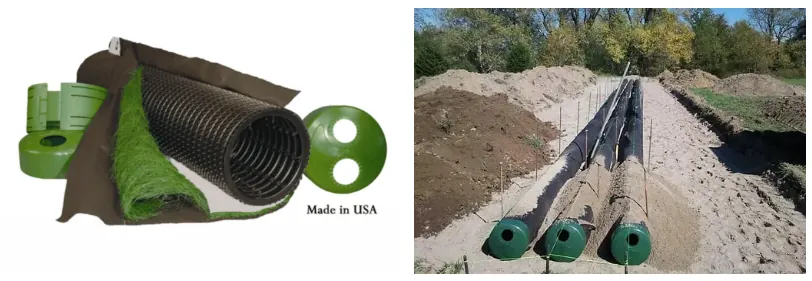
By utilizing simple yet effective natural processes, the Presby Treatment System treats septic tank effluent in a manner that prevents suspended solids from sealing the underlying soil, increases system aeration, and provides a greater bacterial treatment area ("biomat") than traditional systems. The system uses the same tank and the same D box, but the difference is the distance between the pipes in the leaching field, and each of the pipes is wrapped with a special material to slow down the drainage into the ground. Presby systems are used when the ground has a slow perc rate and/or you need to build the field in a tighter space by putting the pipes closer to each other.
Anaerobic septic systems involve the use of bacteria that don't require oxygen to live. In an anaerobic system, you've got a septic tank with two main pipes. One of these goes to the house, and the other heads out into your yard. That main pipe splits into several pipes that sit just below the surface of your lawn.
Inside the septic tank, solid waste settles and is eaten by the anaerobic bacteria. Liquid waste floats to the top. Wastewater from the tank moves out to the smaller pipes under the surface, which have holes at their ends. The wastewater then filters, or "percolates," out into the soil. Typically this system uses two tanks.
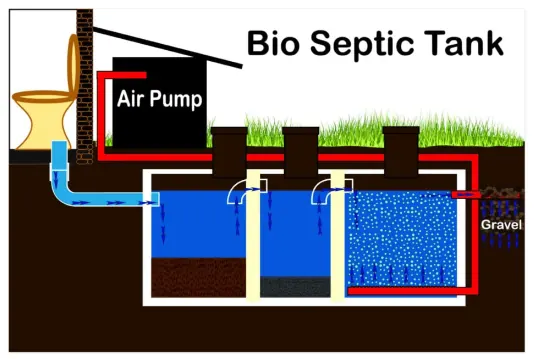
An aerobic wastewater treatment system, often called an aerobic septic system, is a small-scale sewage treatment system similar to a septic tank, but it uses an aerobic process (adding air or oxygen) for digestion rather than the anaerobic (without air) process used in septic systems.
Adding air promotes the growth of organisms that break down the solids, which are put through a clarifier and chlorinated for disinfection, producing a cleaner, more environmentally friendly discharge. This cleaner discharge eliminates the need for a drainage field (leach field), allowing the system to be installed on a small property where a standard septic tank system would not have been possible. Typically this system uses 3 tanks and is ideal for areas where the space for a septic system is very small and/or close to a body of water, with no room for a proper septic system.
We hope you have enjoyed this blog. Please keep coming back for more helpful information.
David and Fiona King of The King Team are a dynamic duo leading a group of seasoned professionals specializing in various real estate sectors. The team's broad expertise spans new home construction, subdivision and land development, commercial property, and multi-family and single-family homes.
David and Fiona are committed to making the buying or selling journey enjoyable and informative. The team prides itself on excellence in customer service, always prioritizing their clients' interests in every transaction. Contact them today to get started.
Beyond their real estate prowess, The King Team also holds expertise in lake home sales and acquisition, land development and commercial real estate, providing a comprehensive service to their clients. The team is devoted to realizing their clients' real estate dreams and is eager to cultivate long-lasting relationships built on trust and mutual respect.
David and Fiona King of The King Team have over 40 years of experience and over 125 five-star reviews. With their top-tier service and professional guidance, you can confidently navigate your next real estate journey.
No other agents do what The King Team does for their sellers. From the custom signs, large EDDM mailers, 3D virtual tours and so much more, call The King Team to discuss listing your home at 888.THE.KING (888.843.5464).
Shallow wells, deep wells and town water compared, a simple whole house filter and softener setup, and how water heaters and hydronic systems make hot water.
Read the articleWhat it costs to run a home: water
How to size a generator from your electric bill, why propane beats gasoline, what portable and whole house units cost, and why a UPS keeps your router running.
Read the articleWhat it costs to run a home: generators
How power reaches your panel, how to read the bill, and what one porch light, an old garage fridge and electric baseboard heat really cost to run each month.
Read the articleWhat it costs to run a home: electricity
Discover why we are rated #1 in buying and selling real estate in Lewis Smith Lake, Cullman, Jasper and the surrounding areas.
David and Fiona King lead The King Team at RE/MAX Patriot Realty, with expertise spanning new home construction, land development, commercial property, lake homes and single-family homes across Cullman, Jasper and Lewis Smith Lake. Call 256.803.5600 or 888.THE.KING, or visit the office at 3850 AL 69 S, Cullman, AL 35057.

Broker & Owner
“Your realtor should be your advisor, to protect you, and help you find the ideal home/property for your wants and needs.”256.803.5600Email David



Get instant property value now!